
Singapore Healthcare Employers
Nurse Staffing in Singapore: Agency vs Direct Sourcing
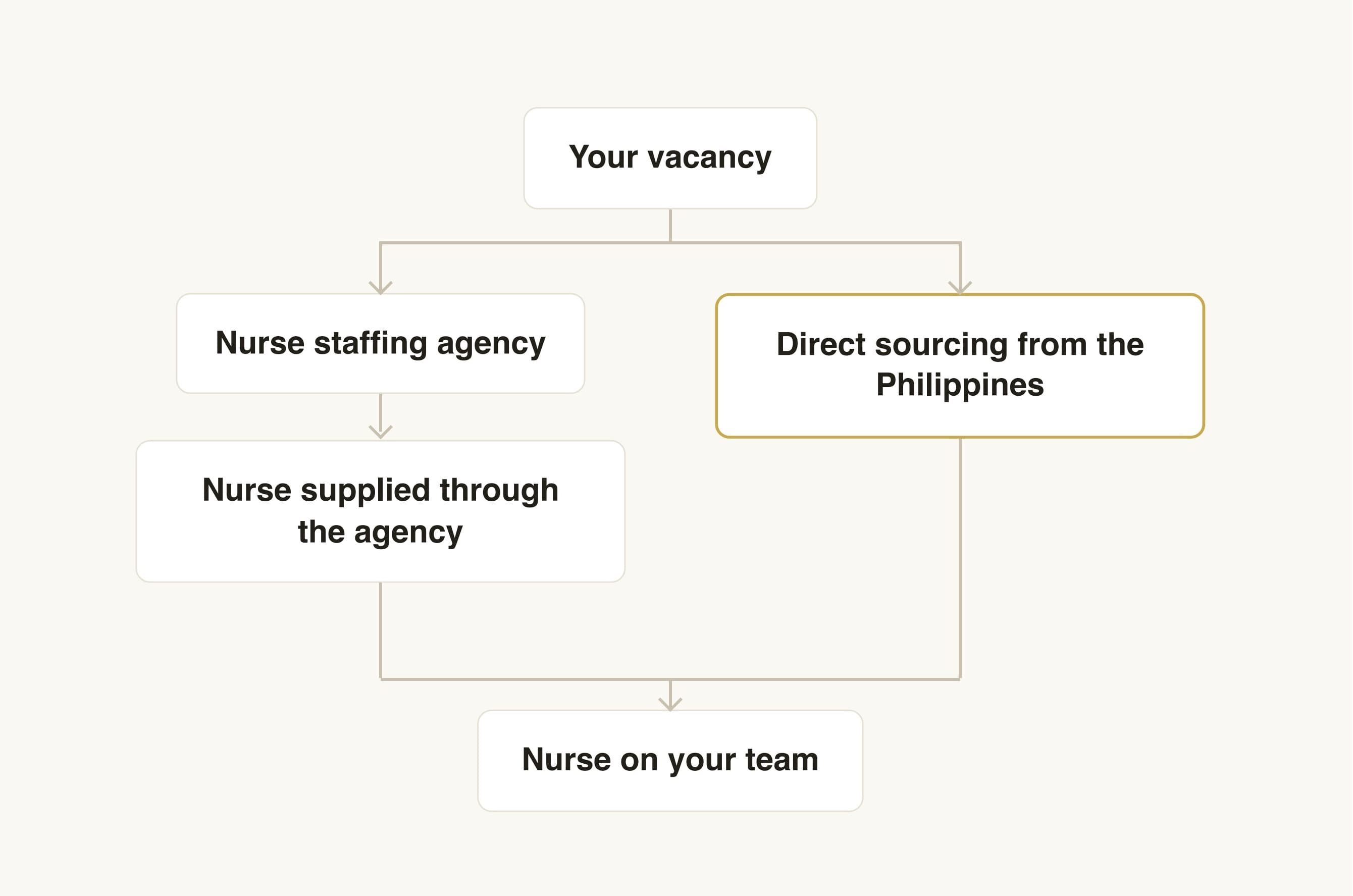
Singapore institutions hiring Filipino nurses can engage a local staffing agency, or source directly from the Philippines with the institution as its own accredited principal. Both are legitimate. The trade-offs are cost, speed, and control. This page sets out how each route works and what to check whichever one you choose.
The core question in Singapore is who employs and sponsors. Through a local agency, placement runs via a MOM-licensed intermediary. Through direct sourcing from the Philippines, your institution is the accredited principal, the direct employer, and the work-pass sponsor. SNB registration is employer-sponsored on both routes, and for Filipino workers the candidate never pays fees on any compliant route.
The local agency route
A MOM-licensed employment agency acts as the intermediary. It sources and presents candidates, and charges the institution a placement fee per hire. Candidates are often already onshore, which can suit an urgent single vacancy.
The employing institution is still the work-pass sponsor and applies for SNB registration. The agency handles the introduction, not the employment relationship.
Direct sourcing from the Philippines
Here the institution is its own accredited principal and the direct employer. BW Medical Staffing handles sourcing, vetting, and Philippine-side processing under the Department of Migrant Workers (DMW) framework, and the candidate never pays fees. SNB registration is employer-sponsored, exactly as it is on the agency route.
Pricing: one month's salary plus USD 500 →
A single point of contact carries the brief through vetting, PRC verification, work-pass and SNB support, and arrival, so you do not manage separate suppliers. This route suits institutions building a permanent, directly employed team rather than covering a single shift.
See how the end-to-end hire runs on the Singapore healthcare staffing process page, and the registration detail in the SNB registration guide. For the regulatory framing, see direct hiring under DMW rules.
The two routes at a glance
| Local staffing agency | Direct sourcing from the Philippines | |
|---|---|---|
| Employer of record | Your institution | Your institution |
| Work-pass sponsor | Your institution | Your institution |
| Candidate fees | Prohibited for Philippine workers on both routes; verify your provider complies | |
| Cost | Placement fee per hire, plus any onshore premium | Per-placement fee paid by the employer |
| Speed | Fast where candidates are already onshore | Brief to arrival typically 2 to 4 months |
| Candidate pool depth | Limited to who is onshore and available | The full Philippine pipeline, screened to your brief |
| Accountability | Introduction only, split across parties | One point of contact from brief to arrival |
| Best use | Urgent single vacancy, onshore cover | Permanent, directly employed teams |
Questions to ask any supplier
Use this short checklist for anyone you evaluate, agency or direct. Clear answers are a good sign; vague ones are worth pressing.
Can I see SNB eligibility and PRC verification evidence for each candidate before I interview?
Who holds the employment contract, and who is the work-pass sponsor?
What happens if a candidate does not complete registration?
What is included in the fee, and what is billed separately?
Does any part of the process ask the candidate to pay? The answer must be no.

Ready to compare on your own brief? Start with hire Filipino nurses in Singapore. Weighing the same decision elsewhere? See the same decision for UAE employers →
Common Questions
No, not for institutions. A hospital, nursing home, or licensed home care company can be its own accredited principal and source directly from the Philippines, and we support both routes. A MOM-licensed employment agency is one option, not a requirement.
Always the employing institution. Whether you engage a local agency or source directly from the Philippines, the hospital, nursing home, or licensed home care company is the work-pass sponsor and the employer of record.
The employer. Candidates never pay fees at any stage, on either route. For Filipino healthcare workers, charging the candidate a placement fee is prohibited under Philippine overseas employment rules, and any model where the worker pays would not pass a recruitment audit.

Weighing your options? See the Singapore healthcare staffing process.
UAE · Saudi Arabia · Qatar · Singapore