For UAE Employers
Nurse Staffing in the UAE: Agency vs Direct Sourcing
UAE hospitals, clinics, and care groups hiring nurses have several options, and the labels can blur. This page sets out the main options an HR director weighs, what to check whichever one you choose, and the questions that separate a compliant provider from a risky one. It is written to help you compare, not to sell a single answer.
The core difference in the UAE is who employs and sponsors. Through a temp agency, staff stay on the agency's books. Through direct sourcing from the Philippines, your facility is the direct employer and visa sponsor, and for Filipino workers the candidate never pays fees on any compliant route.
The options on the table
There are three main ways to staff nurses in the UAE. Each has a place, and the right one depends on whether you are covering short-term gaps or building a permanent, licensed team.
Local staffing agencies
These supply nurses on a temporary or contract basis to cover shifts or short-term absences, often with staff already in the country. The agency is usually the legal employer and bills the facility for the placement or the hours worked.
It is flexible for cover, and less suited to building a permanent, directly employed team.
International recruitment agencies
These source candidates from abroad and place them with an employer, who usually becomes the direct employer, a direct hire, on arrival. Standards and compliance vary widely between agencies, so the checks in the next section are most important on this route.
Direct sourcing from the Philippines under the DMW framework
Here the employer recruits qualified nurses directly from the Philippines, with licensing checks, visas, and government clearances handled through a single point of contact. Every placement runs under the Philippine Department of Migrant Workers (DMW) framework, which governs overseas employment contracts and worker protection.
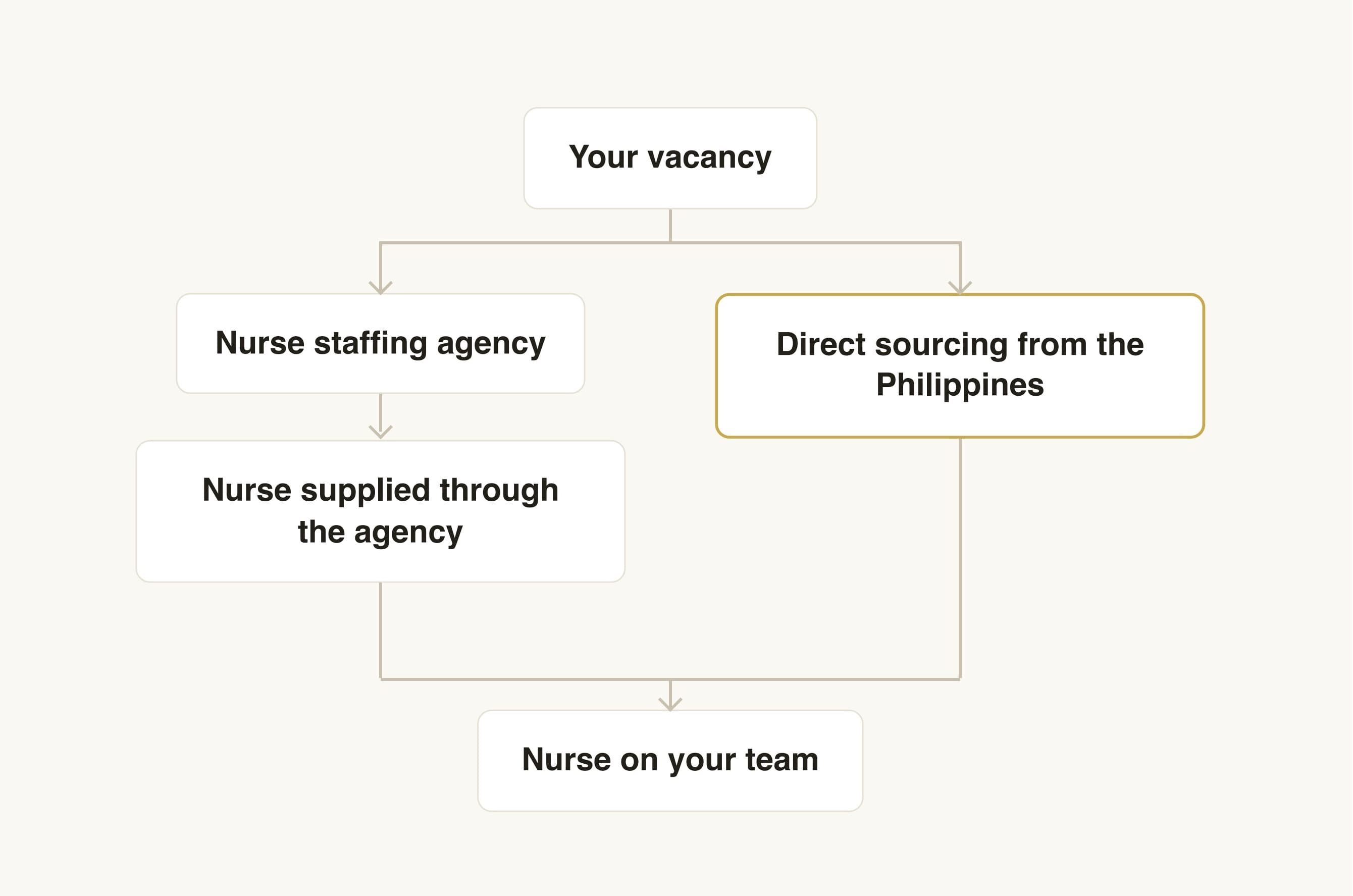
The three routes at a glance
| Local staffing agency | International recruitment agency | Direct sourcing from the Philippines | |
|---|---|---|---|
| Employer of record | The agency | You, on arrival | You |
| Visa sponsor | The agency | You | You |
| Candidate fees | Prohibited for Philippine workers on every route; verify your provider complies | ||
| Best use | Short-term shift cover | Overseas hires, varies by agency | Permanent licensed teams |
What to check, whichever route you choose
The route matters less than the diligence behind it. Whichever option you choose, the same key checks protect your facility, your patients, and your compliance.
Licensing eligibility, confirmed before shortlisting
The UAE licenses through separate authorities by emirate: DHA in Dubai, DOH in Abu Dhabi, and MOH UAE across the northern Emirates. A credible provider confirms a candidate can register with your authority before you interview, not after you hire.
DataFlow primary source verification
Qualifications and registration should be verified at source, with issuing bodies contacted directly, not accepted only from documents the candidate presents.

Who the legal employer is
Be clear whether you become the direct employer and visa sponsor or a third party holds the contract and supplies staff to you. It changes your legal obligations and your control over the team.
Who pays the candidate costs
For Filipino healthcare workers, charging the candidate a placement fee is prohibited under Philippine overseas employment rules. Recruitment is employer-funded. Any model where the worker pays fees is non-compliant and would not pass a recruitment audit.
Replacement terms
Ask what happens if a placement does not work out, and for how long a replacement is provided at no further charge.
Realistic timelines
From a confirmed brief, a realistic shortlist window is 3 to 5 weeks, and arrival is 3 to 4 months once licensing and visas are complete. Anything promised much faster should be treated with scepticism, because verification and the authority examination cannot be skipped.
Where direct sourcing fits
Direct sourcing suits employers building a permanent licensed team rather than covering short-term shifts. Under it, your facility is the direct employer and visa sponsor, so nurses join your team rather than a third party.
A single point of contact carries the brief through vetting, licensing, visas, and arrival, so you do not need separate suppliers for sourcing, verification, and immigration. The fee is a per-placement charge paid by the employer, and, as required for Philippine workers, candidates never pay any fees.
Pricing: one month's salary plus USD 500 →
BW Medical Staffing works on this model. We recruit nurses directly from the Philippines, confirm DHA, DOH, or MOH UAE eligibility and DataFlow status before you see a profile, and handle the visas, paperwork, and Philippine government clearances through to arrival.
For the stage-by-stage view, see how it works, and for what shapes a placement, see the cost of sourcing guide.
When you may not need a provider
For a single hire where the nurse is already in the UAE, already licensed, and known to you, self-recruiting can work.
For overseas sourcing, volume, or anything touching Philippine deployment law, a provider carrying verification and the DMW process is the safer route.
Questions to ask any provider
Use this short checklist for anyone you evaluate, agency or otherwise. Clear answers are a good sign; vague ones are worth pressing.
Can I see licensing eligibility evidence for each candidate, confirmed for my emirate, before I interview?
Who holds the employment contract, and who is the visa sponsor?
What happens if a candidate does not pass the authority examination?
What is included in the fee, and what is billed separately?
Does any part of the process ask the candidate to pay? The answer must be no.
Weighing the same decision elsewhere? See the same decision for Singapore employers →
Common Questions
No. For Filipino healthcare workers, charging the candidate a placement fee is prohibited under Philippine overseas employment rules. Recruitment is employer-funded and the candidate never pays at any stage. Any model that asks the worker to pay is non-compliant and would not pass a recruitment audit.
For a confirmed brief, a realistic shortlist window is 3 to 5 weeks, and candidate arrival is typically 3 to 4 months once licensing and visas are complete. Any promise much faster than that is worth questioning, because primary source verification and the authority examination cannot be skipped.
No. The UAE licenses through separate authorities by emirate: DHA in Dubai, DOH in Abu Dhabi, and MOH UAE across the Northern Emirates. A licence issued by one does not transfer to another, so eligibility should be confirmed for your specific emirate before shortlisting.

Weighing your options? See how it works.
UAE · Saudi Arabia · Qatar · Singapore